| December, 1863 | Linn Diary Index | 16th OVI Home Page |
New-Year's morning. Weather very cold and disagreeable. Last night coldest of the season. Ice frozen this morning three inches through. Noon - wind goes down and sun has some effect. Cleaning the sand out of our tent this afternoon. Calm tonight but cold. Can hear the Gulf roar again - a good sign.
Saturday, Jany. 2, 1864
Drizzling all day. Are mustered for pay this morning. Wrote a long letter to Lizzie. Beginning to throw up earthworks above camp. Talk of rebels attacking us.
Decrow's Point, Texas, Jany, 2, 1864
Two very precious letters from you reached me last Tuesday night just as I was about retiring. I'll bet I violated the rules of camp by keeping the light burning after time to read them. Had to tell the Officer of the Guard a little fib though. I told him one of our boys was sick and had to take medicine at ten o'clock. Fenner, my bedfellow, was sick but did not need the light to take his medicine.
We have just come through another of our Nor'Westers - the longest and hardest we have had since our arrival. It commenced Wednesday with rain and wind from the South-West - soon the wind blew from the North-West and blew so hard and cold a person could not stand it to be out very long without shelter. Wednesday night the wind blew down half the tents in the regiment and the poor fellows had to lye under the canvass all day Thursday, Thursday night and yesterday till evening before the wind fell so they could put up their tents again. Fire was out of the question, we had no wood and if we had the wind blew too hard to build fires. Fortunately for me and my mess, we procured timber when it was to be got and braced our tent well. It has stood all the storms since but I was kept on nettles all the time lest it would give way and go. Yesterday morning ice was frozen three inches thick in kettles left out. The first ice I have seen this season. Mr. Fenner and I have two blankets apiece and can sleep warm if it is cold. The wind is coming from the East this morning and it is trying to rain. I am afraid it will get around to the North-West and we will have another wind storm. These Nor'Westers are the worst things we have to contend with here, the rebels, who are entrenched some forty-five miles up the bay, are not expected.
I received "When this Cruel War is Over" and the answer. I think they would be real pretty played on the melodian and sung. I sent you an answer to "Cruel War" in my last, which was written by one of the 49th Ind. boys.
You ask me how old my little brother and sister were and how many brothers and sisters still living. I have four brothers and three sisters living. My oldest brother, Brownhill, is at work in Holmes County. Cicero, my second, is in Fort Wayne. It is with him I think of going in partnership. Ezekiel, Ida, Julia, Willie and Aggie are still at home. Zeke about 15 and Aggie about the age of Zillah. The little twins were about seven months old when they died. I never saw them. Mother said in one of her letters: - "I feel lonely. I miss Lizzie and Cappie most just now. This time last year they were my constant companions. People told me when the little twins came our loss was made up, I said no, one child can never fill the place of another (and neither can they) but now when they are taken away it seems as if Lizzie and Cappie were taken again." Yet it was hard, very hard stroke on poor Mother. But she is a Christian and with Christian fortitude has borne all her trials. She goes on to say in the same letter - "This has been an eventful year in our family. Yet our changes have all been meted out in mercy. We have more reason to be thankful than complaining. May you and I and all of us be found watching and prepared for any event that may happen."
But excuse me for writing so much which, although of so much interest to me, may not be to you who are yet a stranger to them.
Sunday, Jany. 3, 1864
Drizzling this morning. Noon - sun out and fog lifting. Sold Diary to Frank Wilson for forty cents. Wrote to Becky Powers. Dress parade this afternoon. Evening - drizzling again. Copied Gov. Tod's letter to Major Mills.
Monday, Jany. 4, 1864
Drizzling all day. Wind veering round to the North-West - very cold. Wrote letter for the Republican.
Decrow's Point, Texas, Jan. 4, 1864
Mr. Griffith: -- Thinking a few lines from the old 16th might not be uninteresting to your readers, I will devote a few minutes of this wet, disagreeable afternoon to their amusement, if not benefit.
This is the most changeable climate I ever saw. One day it is warm and pleasant, the next colder and more disagreeable than the North side of the North Pole. I will give you a history of the past week, and how the soldiers of the 16th regiment spent their holidays. Not in sleigh-riding, rabbit hunting, and the many other pleasant ways we used to spend them; you may bet. Neither are we "feather-bed-soldiers," with splendid barracks, and free access to cakes, pies, good cider, and last, though by no means least, to those smiling pieces of calico which eat your sugar candy, pull your whiskers and gaily slap your face. No, we came out for the hard knocks, and I am rather inclined to believe we saw a few of them, too. But to my diary:
Christmas was one of those sunshiny, autumnal days, we had so many of during the last month. We had a day's rations of flour issued to us as a rarity, that morning - a change from the monotonous crunching of hard-tack, quite acceptable to all. There is no drill, and all the sports of the soldier were resorted to to pass the time quickly and pleasantly.
Saturday -- A great change in the weather. Instead of the bright sunshine of the day before, dark clouds, with lowering aspect move slowly through the air, while fitful gusts of rain and wind foretells the coming of the furious strife of elements. Soon the wind veers round to the North-West, and then comes down upon us with unrelenting fury, sweeping everything before it not fastened with firmness of a rock.
Sunday -- About noon the wind goes down, and before night the sun warms the air, and we have another autumnal evening.
Monday -- Skirmish drill occupies the morning hours. Battalion drill and dress parade take up the afternoon. Day pleasant.
Tuesday -- Exercises as yesterday; also, warm and pleasant. In the afternoon the beautiful and staunch steamer St. Mary's arrived at the wharf, and after "tattoo," a large mail was distributed to the boys. Nearly every one heard from home and friends. The papers brought news of Grant's glorious victory over Bragg, and Burnside's successful repulse of Longstreet at Knoxville. Of course, with such news we are in the best of spirits. Nothing is more prized by the soldier than a good letter from friends at home. Friends, you who love the soldiers cannot show it better or cheaper than by sitting down and writing him a long friendly letter. Need not fear we will not receive it. If "Co._ 16th O.V.I., vis New Orleans, La." is written plainly on the envelope, I will guarantee it to reach us in nine cases out of ten. The Republican is a welcome visitor, always looked for with interest, and a mail never arrives without at least three or four asking, "Tom, did you get a Republican?"
Wednesday - Sky threatening, with frequent gusts of wind and rain. In the evening the wind rises, and by nine o'clock has increased to a perfect hurricane, a regular Nor'wester. Half the tents in the regiment were blown down or torn in shreds before morning, and no signs of the storm abating.
Thursday - Was spent by all trying to keep warm. Those whose houses are down creep under the fallen canvass, to shiver and shake till the wind goes down, so they can rig them. Storm rather increasing.
Friday - New Year's Day. The wind too high to cook; great difficulty making coffee for breakfast. Dinner; feast on hard-tack without coffee. Last night was the coldest of the season; ice froze three inches thick in kettles left out. First ice we have seen this season. The wind goes down this evening.
Saturday - Drizzling rain all day.
Sunday - Drizzling in the morning, but about noon the sun came out and fog raises somewhat.
Monday - Today the same old drizzle reigns supreme. The wind is shifting to the north-west, with a fair prospect of blowing "big-guns" again before morning. I look for a disagreeable night. Below I send you a copy of Gov. Tod's letter to Major Mills, acknowledging the receipt of our old flag.
The State of Ohio, Executive Department
Columbus, November 30, 1863
Major Milton Mills, 16th O.V.I., Berwick, La.:
Dear Major:
Your letter of the 2nd ult., accompanying the battle torn colors of the noble 16th Ohio, and giving its history, with the several battles through which it has been safely and bravely borne by your gallant command, reached me sometime since. At the first leisure I take great pleasure in thanking you and your gallant boys, in the name of Ohio, for this honorable testimonial of their heroic patriotism and great perseverance in the holy cause of our country. This brave old flag, with your letter attached, shall be placed in the room provided in our State House, as a proud memento of the enduring valor and great services of the glorious 16th. Please convey to your brave command my profound respect and admiration. May God grant their continued success and safe return to their friends.
Yours truly,
David Tod, Governor.
Tuesday, Jany. 5, 1864
A Nor'Wester blowing all day. Kept under our blankets to keep warm. Mail in this evening. Received letters from Lizzie, Dave Williams and a Republican.
Wednesday, Jany. 6, 1864
No warmer this morning. Have drawn no rations for three days. None at Division Commissary. Noon - wind lulling somewhat. Evening - wind higher again - very cold.
Thursday, Jany. 7, 1864
Wind went down about ten o'clock this morning. Our Mess (No. 1) and Mess No. 2 chip in together and buy a barrel of flour for $12.00. Drew nine pigs feet and a few potatoes this morning. Have drawn no bread for four days. Wrote to Lizzie. Report says one of the pickets, belonging to the 69th Indiana froze to death last night.
Decrow's Point, Texas, Jany. 7, 1864
Your letter came night before last just one week after yours of the day before. I answered it as soon as I could afterward for the cold. My answer is still lying here, you will likely get this and it together. No mail has left here since the day before Christmas, just two weeks ago today.
I have almost made up my mind to go in with Cicero and your letter makes me more in the notion than before. I am awaiting and expecting a letter from Cicero which I think will decide me. I wrote him from Berwick and know he has received my letter through Father who had a letter from him before he mailed his last to me. I wrote to learn what capital we would need and his answer is important to me. Father appears to think well of our proposition; he says - "I think it might do very well. Wapakaneta is a nice place and looks as if it would be a business place." This is a good deal for Father to say, he never says much without weighing well and then speaks to the point. The business if carried on right is a very lucrative one; more so probably than even dry-goods besides being more pleasant, to me at least.
You speak rightly when you say I have not capital enough to buy a farm without going to the very verge of civilization. That is just what troubled me. If I had the capital to purchase even a small farm in Ohio and procure the implements to work it, I would not hesitate to take it. You see I am crippled in every attempt by insufficient means. But such obstacles have been overcome and I can and will conquer them if life and health be spared me. How much nicer than sitting here with my blankets around me and my fingers so stiff I can scarcely wield my pen. We have not had an agreeable day for nearly two weeks; either blowing like fury from the North West or a cold drizzling rain equally as disagreeable. It is reported that one of the pickets froze to death last night. He belonged to the 69th Indiana regiment.
Cicero did not use to be any thing like me - not so full of gab -- more quiet and bashful. He is nearly two years younger than I am - is now twenty; has had more business experience than I have and I expect a better business man. Brownhill is my oldest brother's name. He has no trade and works on a farm.
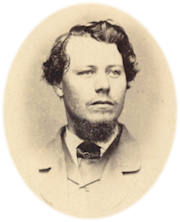
There is a would be artist here. I have seen but one of his pictures and that I would not have. It was blacker than the blackest Ethiopian I ever saw. I will see him and what kind of miniatures he can take as soon as the weather will permit and if I can get any thing of a likeness I will send it to you. I expect if we were to meet you would hardly know me. I am changed so much from the little school-teacher you knew four years ago. I weigh 160 pounds, quite an increase from the 134 I pulled down at the Corner. I have slight chance for whiskers on my chin to say nothing of the superb mustache which graces my upper lip. Hard-tack has set rather hard on my teeth. I have lost one back and one front tooth, with a fair prospect of more going the same way if I do not find something softer in the course of the next thousand years. But if I get off with only the loss of a few grinders in the service of old Uncle Sam, I will be content and think the sacrifice but light. I have numbered this letter "No. 2" because it is the second written this year. My next will be "No. 3" I expect you will have plenty of studying to make this out - my fingers were so stiff with the cold I could hardly write.
Friday, Jany. 8, 1864
Sun out this morning - some warmer. Have regular guard mounting this morning and calls all given today. Joe is washing. Wrote to Jake Hostettler. Take a dose of salts this afternoon. Am quite sick - have chill and fever. Have a large boil on my face.
Saturday, Jany. 9, 1864
Feel some better but lay abed all day and do no duty. Have difficulty to keep warm although the sun is shining and the day is warm and pleasant Take another dose of salt this afternoon. Mail in this evening. Received letters from Hen Levingston , Virgil Sheely, Aunt Love Frey, and a letter and diary from Brownhill.
Sunday, Jany.10, 1864
Am all right again this morning and ready for duty. Air damp and it is trying to rain a little. Arranging and copying my diary into new book this forenoon. Mail goes out at last, first to leave since the day before Christmas. Write to Brownhill and Cy Martin.
Monday, Jany. 11, 1864
Occupied this forenoon in overhauling and burning my old letters. Wrote letter to Dave Williams.
Tuesday, Jany. 12, 1864
Sun shining and weather pleasant today. Wrote letters to Aunt Love Frey and Virgil Sheely. Brigade ordered out double quick this afternoon to go to Indianola, reported fighting up there this evening at supper time.
Decrow's Point, Texas, Jany. 12, 1864
I received your good and interesting letter last Saturday evening. It is just such a letter as I love to receive - so full of encouragement and good cheer but such as always embarrasses me to answer as I wish. You ask a "good long letter" from me. I shall endeavor to write you one in return long enough and as interesting as I know how - of its good - I leave you to judge. You can scarcely conceive the pleasure such letters as yours gives us poor outcasts as it were. I read your letter to my tent mates and although they are strangers to you their eyes sparkled as I went on and all appeared livelier when I was through. It seemed to cheer them almost as much as if they had received good news from their own homes. (I was the only one in the tent who received any letters that mail.) I assure you it was duly appreciated and many repetions will not be offensive.
More than one party would enjoy your surprise should "Tommie just step in now." I know you would entertain me like a prince and then the supper - whew - my mouth fairly waters when I think of it. Wouldn't I look funny a great big awkward soldier who has not used a decent knife and fork for three long years so long that he almost forgotten what such articles are used for, sitting up to a table covered with the very best and nicest good things which the land can afford? What a pretty figure I would cut in fashionable society. Well, I learned to be a soldier and in eight or nine months more I can learn to be a civilian again. Nine months will soon roll round and then for pleasant greetings and happy meetings. Well do I remember our parting at Wooster. I am afraid my promises were not all kept as faithfully as they should have been. Temptations were great, very great, far, far more than I ever imagined they could be.
Poor Lizzie with all her watching and waiting for her absent brother he never came. Little did I think that bright Sunday morning when I half gayly half sorrowfully kissed and bade her good by, and she to conceal her tears turned and slowly passed through the doorway and into the room that I was gazing for the last time on her loved form -- that I should never again see her beaming eyes turned lovingly to mine. I have frequently almost reproached myself that I did not go home to see her while we were at Portland or Cincinnati in spite of all guards, officers and the uncertain penalty of the crime of desertion. Had I gone I expect I should have been pardoned as were others who did go at that time.
I could not tell you all about the battles we have been in in a week. Will have to leave that to talk about when I get back to Millersburg if I should be one of the fortunate ones. You ask how I felt and what I thought -- easy questions to ask but hard to answer. When bullets flew thickest I confess I felt a little scaly and thought one might run against me. But I was not so much exposed as those who carried rifles. I did not have to go into any charges but was frequently where bullets whistled far too thick for comfort. But we can talk of this I cannot find words to express intelligently on paper the feeling of a man about to enter the storm of iron hail. You can only imagine his feelings when he hands his pocketbook or some little keepsake to his comrade to send to friends should he fall and then buckles his belt tighter for the conflict.
You ask if I get home-sick. No I am never home-sick but have sometimes when I get no letters for a long time felt lonely and down spirited. I love to get lots of letters and answer them. It is a good exercise and pays well besides keeps me out of mischief which I would be more apt to be at when I have no letters to write.
This is the first pleasant day we have had this year. It is calm and the sun is out. These Texas winds are cold indeed, coming from the North-west they sweep everything before them. I do not wonder Uncle William and Aunt Sue did not like Texas. By the way do you ever hear from them? Are they secessionists? Which way do Aunt Sue's friends side? Hope with the old flag. When I wrote to Brownhill day before yesterday I did not feel very well - but am all right now. Give my love to Grandmother, Aunt Nancy, Uncle, Willie Sheely and all other inquiring friends. Best respects to Miss Anna Lemon. I should be glad to receive another letter from you soon.
Wednesday, Jany. 13, 1864
Moved up to Indianola on the boat Matamoras. Two regiments, 16th Ohio and 69th Ind. on the boat. Are quartered in houses. Four Companies A, B, D, and E in this house which has seven rooms downstairs and four upstairs. Fenner and I put up a bunk for us to sleep on.
Thursday, Jany. 14, 1864
Putting things to rights this morning. Inspection this afternoon by regimental officers. Major Mills was thrown from his horse but fortunately was not hurt much. Commenced a letter to Lizzie.
"Our Place" Indianola, Tex., Thursday Eve
Jany. 14, 1864
I hardly know how to commence this letter - it seems so funny to be writing in a house again even if I am writing on my knee.
I guess we have reached the "comfortable quarters" at last, which Gen. Washburne promised us at the close of a "ten days march" when we were at Carrollton. Been more than ten days coming through though, don't you think so? There are four companies in this house - A,B,D, and E. We have a nice story and half house, nicely painted - has belonged to the upper crust. There are ten rooms large and small in the house - seven down and three upstairs. Nineteen of us have one room about 16 feet square and 10 high. One corner is occupied by six men in three bunks one above the other - another has two bunks for six men - a third is occupied by five men in two bunks while Mr. Fenner and your soldier boy have the other corner all to themselves. We have our bunk put up between two windows to the lightest and I think the best corner of the room. We put up our own bunks. Now I have told you all about our house and room but had almost forgotten to tell you where we are and how we got here. But as I have commenced at the wrong end I will keep it up and tell you that we are in Indianola - or as it is sometimes called here Powder-horn. It was quite a stirring place before the war -- had about 2,500 inhabitants although it is now pretty deserted. A little fellow I was talking to this morning says the men have all gone into the army.
(I can scarcely write there is so much confusion in the room, some are singing, some playing cards, some tearing things up generally making all the noise they can conveniently, while two are reading and three of us trying to write -- no wonder I get everything in wrong end foremost.)
Now for a brief review of the past three days. Tuesday every thing was going on as usual till about three o'clock when heavy cannonading was heard in this direction and in half an hour after the long roll beat in camp. I tell you now there was a rush about that time and in a very few minutes every body was out ready for a move. Fortunately the order was countermanded and we were ordered to be ready to move the next morning at seven o'clock. We were ready yesterday morning at the appointed time - had every thing on the boat but did not get off until about noon. Came up in the afternoon and were in our house and hard at work putting up our beds before dark. It is about twenty miles to Decrow's Point by water -- not so far by land.
I will close for tonight -- will keep this open till mail goes out - will write more probably. Am looking for a letter from you the next mail. I learned at tattoo tonight that our drum corps will have to go into quarters by ourselves in the morning. We are to go into a house with three rooms - will be about a dozen of us in the whole house. I think we will have a gay time.
Sunday Eve., Jany. 17, 1864
Our gay time in "our house all by ourselves" did not last long. Friday morning the drum corps went to their new quarters and all of us went to work with a will to rig up - worked all forenoon as busy as nailors -- got our bunks up and part of our other little conveniences when orders came to pack up ready to move immediately.
We considered the propriety of bringing in a file of soldiers to swear - but finally concluded that even with their aid we could not do the subject justice and so desisted. Four of us, our fife Major, two other fifers and I occupied one room, had a couple of nice bunks up - a convenient cupboard and were just ready to put up a stove. You see we were having things nice. I can't write today - can't think of what I want to say and will stop.
Monday, January 18, 1864
We moved from town Friday evening. Saturday morning we had a grand review of our division by Gen. Benton. I assure you it was grand. The review was held on a large plain and we had a splendid view of all that was going on. There were eleven regiments and one battery of artillery - three brigades. Gen. Warren the commander of the first brigade wears the old style military dress. He presented quite a showy appearance, with his fancy continental hat and plume waving gracefully backward and forward in the stirring breeze - his gaudy golden tipped epaulets dangling from his shoulders as he rode his coal black charger up and down the line. This is the first old fashioned uniform I have seen since I was a very small boy playing in the streets of Millersburg. After we had marched by the General's stand and taken our places in the line again Gen. Warren rode up to Major Mills and asked if he was in command of that regiment - pointing to the 16th Ohio. Being answered in the affirmative he said "Splendid regiment, Splendid regiment, does my soul good to see such a regiment - makes my eyes water to look at them." We did do well that day. When marching by Gen. Benton the music wheeled out of the line till the regiment passed so I had a good opportunity of seeing the boys when marching by us and there was not the least crook in the line of any company.
We received a mail this morning but there was no letter for "poor me." I was looking for an answer to my letter of Dec. 2nd but mails were so uncertain when we first came to Decrow's Point. I am afraid they will be more so when we leave here. I look for some more hard marching when we start again. May not go though for five or six weeks and then again we may leave inside of a week. I hear there is an artist down town and want to go down this afternoon or tomorrow to have that miniature taken for you. They are calling for letters and I will close this and send it. If I can get a good picture will send it in my next.
Shreve, Wayne Co. Ohio, Jany. 15, 1864
My good young friend and most noble Union Soldier. I received a day or two ago your very kind and flattering letter dated Dec. 15th at Decrow's Point, Texas. I thank you many times for thus honoring me with a letter; I wish could reciprocate the favor, but such as I have I will freely give unto you. It is true as you say I feel a special interest for the soldier - for you specially, for I know the purity of your nature and your ardent desire for your country's welfare. The regiment to which you belong - the 16th has justly earned a fame for gallantry and nobleness of purpose - will be engraven on the pages of history, and will be read with interest long after this poor body of mine, shall be forgotten. You ask an excuse for writing to me, why my dear young friend I esteem it a great honor to be remembered by those noble soldiers, in our Glorious Union Army who are showing their "faith by their works." For it is said "By their works shall ye know them." It is true I am for the Union and the "Enforcement of the Laws." But I sometimes feel ashamed that I am doing so little toward the same, while others are doing so much. To be sure we here at home give a little money now and then but what is that to the exposure that you endure that we here may live securely. I said I am in favor of the enforcement of the Laws, there is no way of enforcing law, only by the force of human effort. There can be no good Government only by the enforcement of the law. This is what the noble army that you belong to, are engaged in, therefore, if a word from me would be of any value, I would say go on in this most noble cause, until there is not a rebel to be found either North or South. I esteem the work of putting down this rebellion the greatest work perhaps that men have been called to do, since the world began. Surely those who do the work will have a reward such as have not been awarded to any in all time past. You my dear young friend may fall as many have already done -- but if so, yo
u fall in a most holy cause -- the cause of your country's and may He that has thus far watched over our country's destinies reward you. As many of you as may live to return to enjoy the smiles of friends at home, will be received with a similar welcome, to the one described by you to your Uncle, when the paroled boys joined you. The letter above mentioned was published and read with great interest.
I can well appreciate your feelings as expressed about the Copper Head portion of our community; to exhibit the "cloven foot" by all such is never difficult. But never mind my friend, the time will come, that it will be said that "such and such" belonged to the Union Army, he was one that "fought at Vicksburg or at Port Hudson or at Gettysburg or other place in the war to put down the slaveholders rebellion. These will be honored, praised and feasted, they will be honored with the best gifts of a grateful country. And then they will also have the approbation of their own bosoms. There will also be other "such and such" of whom it will be said they voted for a traitor for Governor. They professed to be for the Union, while they were always finding fault with the Government and its' Army. It will also be said they encouraged desertion by writing to them that they should not fight to free the "Niggers," and that this was only war for the Abolish- ionists, etc., etc. The time will come and I think it is near, that men, if they are capable of shame, will be very much ashamed of their doings and sayings of the present time. Indeed I am told that some young men now in the army are ashamed of some of their nearest friends at home in consequence of traitorous letters sent to them. Benedict Arnold the traitor of the revolution had his day, and the Tories of the same time had their day, and so will the Traitors of the present time have their day. If some of them don't wish they had never been born it will be queer indeed.
You say I have doubtless learned that you are on the sandy beach of Texas. Yes, I saw the account of the trip published with the success of taking the Fort etc. But I can assure you, I read no account published that interested me so much as the one from your own pen to your Uncle as Published in the "Holmes County Republican." The description down the noble Mississippi (that your regiment contributed so much to open) was most natural. The trip over the Gulf with the sea sickness was portrayed to the life. I hope I may yet live to read many such from you and others.
I suppose I have seen the shelter tents you speak of. We had a great general muster of the Ohio Militia last fall at Wooster, lasting I think eight days. There was quite a large body of men and officers collected to drill and learn the art of War. They were provided with tents a portion of which, were the same that you describe, they would barely do to shelter a little from a shower, but would be poor protection in cold weather. I feel especially glad to hear that you have plenty to eat. I have heard it said that a certain General should have said if they would give him Irishmen half drunk, French men half-starved, and Englishmen with a full belly, then he could whip any army of equal numbers that could be brought against him. We Americans I think go for plenty to eat, at least the substantial, such as you describe -- crackers, coffee, pork and beans. But the more especially pleasing intelligence you give is "The boys are all in good health and appear to enjoy themselves as well as could be expected." I hope you may continue well and enjoy your-selves to the end of your time or the end of the war as the case may be.
You will please say to Mr. Yarnell that I received his very welcome letter and answered it partially yesterday. I say "partially" for I intend if not hindered in some way to write him again in a week or two, so that he may get a letter from myself or others every mail that does come. I can well anticipate your disappointment when a mail comes and you do not get the expected letters from friends at home. I can't say any thing about your Father's family, but suppose they are well. Now in conclusion my young friend be of good cheer. Your Government is doing all it can to sustain you, and soon, as soon as possible your ranks will be filled by new recruits, either of volunteers or conscripts. A letter from you or any of the boys, will always be acceptable. The Lord bless you. I am yours in friendship.
Friday, Jany, 15, 1864
Musicians ordered to go to a house by themselves. Wash Littell, George Notestine, James Rickerd and I have a room. There are three rooms in our house. Noon. Almost fixed up and have to move to commons and put up our tents again. Don't know the cause.
Saturday, Jany. 16, 1864
Grand review of our division by Gen. Benton beginning at 10 o'clock this morning. The 16th O.V.I. was highly complimented for its soldiery appearance and good marching by Gen. Warren commander of the first brigade. Dress parade this evening.
Sunday, Jany, 17, 1864
Went down town for my drum stick and stop at church as I came back to camp. Went down to church tonight again. T. Anderson of the 22nd Iowa regiment, preached. Ike McCullough came back to the regiment tonight.
Monday, Jany. 18, 1864
Mail in -- received a Republican. Finished and sent my long letter to Lizzie. Fenner and I have our miniatures taken this afternoon -- cost $1.00 each. Dress parade this evening.
Tuesday, Jany. 19, 1864
Wrote a letter for Nate Young. Fixing up our tent. Brigade inspection at two-thirty this afternoon. Baking this evening. Dress parade.
Wednesday, Jany. 20, 1864
Began a letter to Hen Levingston. Making a drum stick -- mending my pants and reading this forenoon. Afternoon. Brigade drill and dress parade. Make a shanty for Joe and my drum. Finish my letter to Hen Levingston and take a smoke.
Thursday, Jany. 21, 1864
Wrote a letter to the Republican and commenced one to Lizzie Shera. Brigade drill this afternoon. Small mail in -- nothing for me.
Indianola, Texas, Jany. 21, 1864
All things must have an end. When I wrote you last, we were in the midst of a regular Texas Norther. After we had experienced nearly three weeks of this stinging cold, the winds calmed down, and the chill, damp air was dispelled by the genial rays of old Sol, who appeared on the scene early on the morning of the 12, and smiled generously upon us. I assure you that his presence was welcomed, if not with loud demonstrations, with no less sincerity, by glad and joyous hearts. I used to think that it never got cold in Texas; but one winter season here is enough to draw the blinds from a man's eyes and make him think of a good thick overcoat, or a snug seat by a glowing fire. Citizens say the winter is broken; that we will not be apt to have any more long cold spells; none to last much over a day and night at a time.
We have fortunately been on the coast all winter, where, although the wind blew with almost resistless fury, we have had very little rain, which, in our poorly protected condition, would be disagreeable in the extreme.
About three o'clock in the afternoon of the 12th cannonading was heard in the direction of Indianola, at first by single discharges, then in quick, rapid discharges, as though in hot engage-ment. Not long after the long roll sent its thrilling notes through our camp, and the boys were seen springing to their tents in rapid haste, to prepare for the supposed coming conflict. You would be astonished to see how quickly a regiment can get out in line of battle when inspired by the soul stirring alarm of the long roll. Blankets were hanging out to air, knapsacks were unpacked, and things lying around loose for convenience in camp, and yet, in less than fifteen minutes every man was ready to march to the boat which was to take us to the scene of action. But by this time the firing had ceased, and we were ordered to our quarters, with instructions to be ready to move up to Indianola the next morning at seven o'clock. We afterward learned that the cannonading was the 7th Michigan battery shelling a large body of rebel cavalry who were reconnoitering our position. Our infantry did not become engaged, if we except one volley fired by the 8th Indiana.
Early on the morning of the 13th we were up and doing, but did not push off from the wharf till near noon, arriving here early in the evening. The distance between Indianola and Decrow's Point is about twenty miles by the bay, but not more than ten or twelve by land. When we first came here we were quartered in houses, and began to think we had at last found the "comfortable quarters" General Washbourne promised us at the close of a ten days march," just before we left Carrollton for our trip up the Teche. We were two days and nights in the houses, and were having things put up comfortable and convenient, when we were ordered to move back of town and put up our tents again. To say the boys were not displeased and did not curse a little, would be going beyond the bounds of truth. But swearing was of no avail, and here we find ourselves on a low flat just back of town, or rather between what is called old town and new.
Indianola was before the war, quite a thriving country town, of about 2,500 inhabitants. The young men are all in the Southern army. Many of the houses are deserted - the inhabitants still here being women and children. The poorer citizens appear to be in favor of the old Union, and say their friends only wait for an opportunity to come into our lines. The rebel infantry are of this class, and it is only by threats that the officers can make them fight. Part of them were sent to the interior because their officers leaned toward the good old flag, and it was feared would come with their companies to us. When driven from Fort Esparenza, a squad of 120 hid themselves here, hoping we would come right on and take them; but as we did not follow them within the week, they were all picked up and taken off with their army again.
The boys of the 16th are generally in good health. Western Louisiana and Texas appear to be exceedingly healthy localities for Ohio soldiers. I send you a rebel's opinion of the way the Yankees took Fort Esparenza, clipped from the "Horn Extra," a soldier's paper, published semi-occasionally, in this place, for "one (10) Washington in green (10) to defray expenses." If it be not too long please publish it; I know it will interest your readers.
From the "Horn Extra" (Rebel)
Port Lavacca, Texas, December 3, 1863.
After what I wrote you the other day, when I was about to start down to the fort, you will naturally expect me to say something of the "finale" of that affair, especially as it has created quite a sensation in the State, and is really a very unfortunate affair for our cause. Those who are guilty are the very ones that will escape in the whole matter, and these brave officers and men who periled their lives in that "man trap," called Fort Esparenza, are the victims of course, to what ever odium is attached to evacuation.
You have no doubt heard that the work was "splendid," and so it was, for a prettier thing to look at no man would wish to see; and until I saw it tried, I though it the best thing in the world. But it only shows that a man may know very well how to dig a trench or grade a street, and yet know nothing about military matters or preaching. I therefore infer that a man may go to school a "heap," and learn to make a beautiful drawing on paper, and then by aid of the bone and sinew of the country can construct a pretty thing to look at, and yet, after all, not know the first thing about military matters or preaching. This is the idea that occurred to my unmilitary cranium. In other words, the fort was built with the sole view of an attack by water, and if they had made it in that way, they might have hammered away till doomsday, and we would have been there yet; and I have not the slightest doubt but we could have demolished the whole ten vessels that were off the bar. But, unfortunately for us, the enemy knew our weak points, and "lay off the land," just as well as we did; hence, they landed at the west end of the island, in Cedar bayou, where they found no opposition, and took their time to get everything on shore in good order, with their 2,500 veterans and 500 horses, and with all their appliances, came upon us in our rear, picked their locations and went to work on us with their rifled guns, and in a short time got our range to such a nicety that almost every shell dropped into the fort -- every one of which was liable and perfectly able to penetrate one or all of our seven magazines, which were adjoining our bomb proofs, that were intended for the protection of our men, thereby making them the most unsafe places in the fort; in fact, the only safe place about it was the parapet.
Some may say that it is the business of a soldier to die; and that we ought to have staid there till at least half of us were killed, and then surrendered to a merciless enemy, whose motto is "No more exchange of prisoners till the war ends." This very pretty talk for those who are at a safe distance; but I would suggest a change of place for the time being. Let them imagine themselves cooped up in a pen like sheep for the slaughter, and this too, with little or no means to hurt the enemy, while they had all the means to hurt us they could ask. Let them also imagine their number to be only 600, a large majority of whom had never been in battle, and about half the number State troops, who although they were good and true men, yet knew very little about the drill of a soldier, and consequently were not near so effective as they otherwise would be, and that the guns of our fort were located with strict reference to a water attack, and were of very little use for a rear attack from a force of 2,500 veterans, with rifled guns that could throw with as much precession (almost) as an old deer hunter could shoot a buck at 100 yards. I say, let those who are disposed to criticize our evacuation, at safe distance, place themselves in our position for a moment, and then let them say what they would do; otherwise, "let him who is without sin, cast the first stone."
But I have not told all the troubles we had, for the fort is on an island, bounded on the east by Pass Cavallo, where the gun boats would have been up as soon as the norther ended, which proved to be the next morning; on the west and south-west by the enemy, in full possession of the prairie, with their teams, and sixteen horses to a gun, dashing about at full gallop, and taking position wherever they please, as we had no cavalry to oppose them, and the little harm we could do them with our smooth bore guns, did not seem to trouble them at all. In fact, the whole three days' fight seemed to be a sort of holiday for them, and reminded me of a cat at play with a mouse that she knew to be perfectly in her power.
On the north we were bounded by Salura bayou, nearly two miles from the fort, and it a wide deep one, with only one tolerable ferry boat, the rope of which was old and rotten. Then two miles this side is another, called Big bayou, and is, like Big river, also crossed by one frail ferry boat. Then, before we get to Powder Horn, there are two small ones, with a bridge over one and a ferry the other.
Now then, with all these bayous to cross, and by such frail means, with a wily foe, that we knew could surround us at their leisure with batteries, I would like to know what else we could do but evacuate while we could!
I regret this sad affair as much as any one possibly can, but we had the alternative placed before us to evacuate and destroy everything, or wait a day or two and surrender with what men we might have left, there by giving the enemy the full possession of the fort and all our munitions of war. Now, if we could have had a regiment of well drilled cavalry, to have skirmished with them and kept them at bay when they first began to come in sight, till our reinforcements could have got to us, the case would have been different. Yet, with such field batteries as they have got, while we have none, we have got to be pretty strong to fight them, even in the open field. They will no doubt make raids up here among us, and do us a heap of damage, but unless they are largely reinforced, and that soon, we will soon pick them up -- although it would be considered contraband for me to say why I think so. We have news from below this morning, that the whole fleet is inside the bar, also, that two or three heavy guns were heard today near the gulf shore, off the Guadaloupe, and we hope that Semmes has got among them. Our fight at the fort occurred on Friday, Saturday and Sunday, November 27, 28 and 29. For particulars see official report.
Friday, Jany. 22, 1864
No drill today. Finished my letter to Lizzie Shera. Dress parade this evening. Went to church in town tonight. Mail went out. Six of our Provost guards captured by the rebels above Port Lavacca.
Saturday, Jany. 23, 1864
Am twenty-two years old today. Wrote a letter to Mother this forenoon. Brigade drill this afternoon. Mail in - receive letters from Father and Bill Fleming and a Republican. Wrote to Mother tonight.
Indianola, Texas, Jany. 23, 1864
This is my twenty-second birthday and I think I cannot employ my time better than in dedicating it to my Mother, she who gave me birth and so carefully watched over my infancy, guarding and protecting my every step as I approached the sunny period of joyous boyhood, and looked with anxious interest at the developing principles of budding manhood.
What debt of gratitude I owe for a good kind Mother's love. Many, oh, how many have never had a mother's care, have never know the depth of tenderness in those three little words --
"A Mother's Love."
"Sweet is the image of the brooding dove!
Holy as heaven a mother's tender love --
The love of many prayers and many tears,
Which changes not with dim, declining years;
The only love which, on the teaming earth,
Asks no return for passion's wayward birth."
"Blest be the tie that binds" me to that dearest of beings, my Mother,
whose prayers daily ascend to a throne of grace, imploring the great God of battles to
"From blasts that a chill, from suns that smite,
From every plague that harms,
In camp and march, in siege and fight,
Protect her son at arms."
And her prayers have not been unavailing -- I have truly been held as it were in the "hollow of His hand" and while many of my comrades, as good by nature, and far better by practice, have been carried off by the deadly bullet, or still more torturing disease I have been sparred from the leaden messenger of death or the weakening bed of sickness, a living monument of the power of the prayers of Christian parents. Pray on dear Father and Mother for
"Prayer is the Christian's vital breath,
The Christian's native air."
Wicked as I may be I have this one redeeming trait -- I am a firm believer in the power of Christian prayer - sincere and earnest prayer. I have not written home this year yet. My only excuse is that I wrote to Brownhill, Aunt Love and to the Republican and I knew you would see all those letters and hear from me through them, besides I have not received any letters from home since the 29th of December. I answered them right away. I did not get as many letters from home as I would like to have had last year, this long silence seems as though I was destined to receive less this year. We only get mails semi-occasionally and I like to have a letter from home each mail. But maybe I had better not be scolding for I have been rather slow to write home of late myself. I think if I got one each mail I could answer it. What does Cicero mean that he never writes to me? I feel like writing him five or six spicy lines and sending them - would do so if I were certain he had not answered my last letter. I wrote him asking cost of going together, to each, and wanted an answer right away. I do not think I shall write to him until I receive a letter from him if that should never be unless it would be to haul him over the coals and bring him to his senses. Hurrah, here are two letters and a Republican -- I must read them.
Letters were from Father and Billy Fleming. Will answer Fathers as soon as I finish this. I am well although my blood is not in the best state imaginable. I find it is the same with all the boys. If we get the bark knocked off our hands, get a little cut or scratch it is sure to fester and make a very sore place. I knocked the skin off of one of my knuckles New Years morning and it is not well yet -- was real sore but I have kept it tied up with tobacco the last week and it is getting better. I had a large boil on my face, also, at the point -- it too is a long time healing.
There is the first call for brigade drill and I cannot write any more till tonight or tomorrow. Give my love to Grandmother, Aunts, Father and all the children.
Sunday, Jany. 24, 1864
Wrote a long letter for John Edgar to his Mother. This afternoon Fenner and I went down town. Had an oyster supper tonight.
Monday, Jany. 25, 1864
Battalion drill occupied the forenoon and brigade drill the afternoon.
Tuesday, Jany. 26, 1864
Wrote to Billy Fleming and began a letter to Lizzie before drill. Brigade drill this afternoon. Took a dose of salts this morning for my blood.
Wednesday, Jany. 27, 1864
Took another dose of salts this morning. Made a bench. Brigade drill this afternoon. Bought a quire of paper from Frank Wilson for 50 cents. At church tonight. Sermon by Chaplin of the 114th. The 33rd Illinois go home on furlough today.
| December, 1863 | Linn Diary Index | 16th OVI Home Page |