| Previous Reunion | Reunions Index Page | Images | 16th OVI Home Page | Next Reunion |
Second Regimental Reunion
16th Ohio Volunteer Infantry
Wooster, Ohio
July 4, 1874
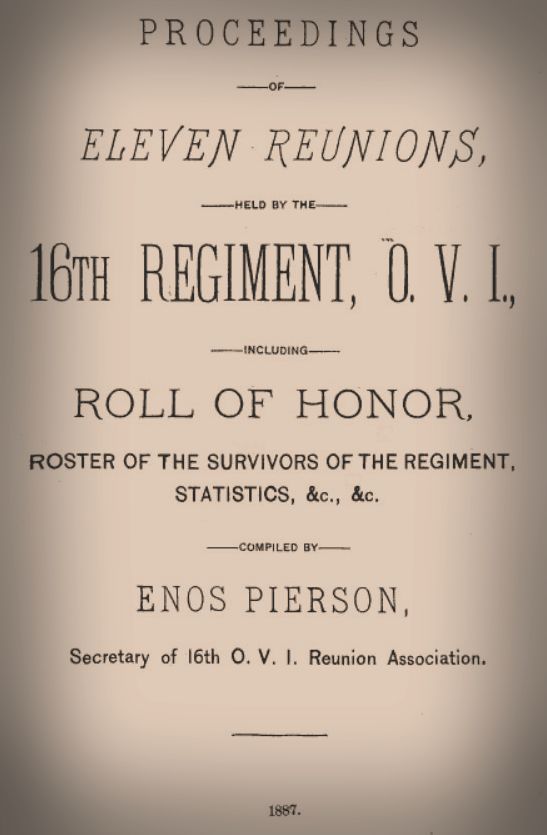
Below is a transcription of the recorded proceedings of the 16th Ohio's second reunion at Wooster, Ohio. It was taken from the Proceedings of Eleven Reunions Held By the 16th Regiment, O.V.I, compiled by Enos Pierson, Secretary of 16th O.V.I. Reunion Association, in 1887. This document was provided by fellow 16th OVI descendant H. Arlan Heiser of Ohio.
Certain misspellings from the original document, believed to be accidental, were corrected, while others were transcribed as recorded.
Second Reunion
AT WOOSTER, O., JULY 4th, 1874.
The Fourth of July, 1874, can be set down as a model of its kind. It is equalled by few and surpassed by none. Heat, dust, smoke and cinders combined, made the atmosphere irritating and oppressive.
Friday night and Saturday morning brought the most of the veterans together, and the firing of the cannon at sunrise, the fu si lade of fire crackers, the stirring strains of patriotic music, made us forget the unpleasant weather and its consequences, and look only to the reunion exercises for enjoyment and recreation. The country people came in by the score, in carriages, buggies and wagons, and by 11 o'clock the streets were blocked, the stores crowded, and the ice cream saloon and soda fountains besieged by a hungry, thirsty and dusty multitude.
The members of the Regiment assembled at France's Hall for a business meeting, and at roll call the following named members were found to be present, to the number of one hundred and forty-seven:
(reunion attendance pages to be developed)
On motion of Col. Kershner, it was resolved that the next reunion of this Regiment be held at Millersburg, Ohio, on the 6th day of August, 1876, the 6th of August being the anniversary of the battle of Tazwell, Tenn., or rather the retreat from Tazwell to Cumberland Gap.
On motion, the following named officers were elected for the next reunion.
President, Capt. Wm. M. Ross, Millersburg; Secretary, H. G. White, Millersburg, Treasurer, Capt. R. W. Tanneyhill, Millersburg.
On motion of Theodore Wolbach, it was unanimously resolved, that it is the desire of the members of the 16th Regiment, O.V.I., present at this reunion, that Congress may grant an honorable discharge to Capt. R. W. Liggett, and Lt. M. B. DeSilva, formerly officers in this Regiment, and that such honorable discharge may date from the day of their discharge from the service.
On motion of E. W. Botsford, the following application was unanimously endorsed.
We the officers and members of the 16th Regiment O. V. I. present at this reunion, respectfully represent that John C. Lake, a member of Company C., of said Regiment, lost the fingers of his left hand by the accidental discharge of his gun while in the line of duty at Lexington, Ky., in December, 1861.
We further represent that we were present at the time of the accident, and are satisfied from the circumstances that it was an unavoidable accident, incident to active military duty, and we therefore respectfully request that inasmuch as he is an applicant for pension 3,817, that he be inscribed on the pension rolls.
No other business appearing for transaction at this meeting, it adjourned to meet in Millersburg, Ohio, August 6th, 1876.
At the conclusion of the business meeting, a line was formed under command of Col. Kershner, and headed by the Independent Cornet Band, marched to Camp Tiffing, where the pork, beans and hard tack were being prepared, and the toasts and responses were to be delivered.
Upon arriving at the ground, Capt. McClure welcomed the soldiers in the following address:
RECEPTION ADDRESS BY CAPTAIN A. S. M'CLURE.
(full transcription forthcoming)
...The 16th Ohio won honorable distinction in war, and its record in peace is above criticism. There is an explanation, however. When the regiment was organized it was emphatically a bachelor regiment. Now, I do not intend to respond to Dr. Chase's toast, but I must unpack my breast of some domestic reflections, of some matrimonial suggestions, the appropriateness of which you will doubtless appreciate. Chase was the first victim on the altar. He couldn't wait until the war was over. Botsford held out with the incorrigible obstinacy of ripe experience. Clark yielded after a tremendous struggle. Cunningham threw up the sponge when he became inextricably ensnared. Kershner, Liggett, Ross, Van Dorn, Mills, Taneyhill, Heckert, Smith, and the boys, by whole platoons and companies, succumbed to the sweet attractions of Ohio's charming daughters, with chivalric gracefulness. I am impelled to state, from statistical computations made on the grounds today, that these civic capitulations have not been wholly fruitless or unprofitable. With what inconceivable joy, with what paternal satisfaction, we take down the old sword from the mantel-piece, unsheath its rusty and battered blade to the astonished gaze of a numerous progeny, dilating with heroic emotions on the rebels it has decapitated, and the battles in which it has flashed. How youthful patriot's breast heaves with emulous desires to excel the exploits of ancestral valor, and how greedily we recognize the dim evidences of hereditary patriotism sparkling in the juvenile's eyes? These occupations solace existence and reconcile us to the other hard lot of uninteresting citizenship. ...
Then followed the dinner. Tables had been erected, tin platters, spoons and tin cups provided, and under the able control of the cooking committee, the port, beans, hot coffee and hard tack were dished up by the bucketful and dealt out to each man's entire satisfaction. They disappeared with an evident relish, and many were the reminiscences of army life recounted while standing around the festal board. Camp scenes assumed a wonderful nearness, and the great events of a three-years' nor were crowded into the short space of half an hour. When the grub onslaught was over, then followed the feast of toast and music. The martial band and glee-club took an active part in the exercises. The toasts appeared and were responded to in the following order:
THE FIELD AND STAFF RESPONSE BY COL. PHILIP KERSHNER.
(full transcription forthcoming)
THE OFFICERS OF THE LINE, RESPONSE BY CAPT. W. M. ROSS.
To those who fell in battle no eulogist can do justice, but we can say in truth they gave their lives for liberty and their country. Peace be to their ashes. To those who have since passed into eternity, we trust that they too receive the reward in store for the good and the brave. To those who still survive, may they as faithfully perform the duty of citizens as they discharged the duties of the soldier when in the field, during the late rebellion.
NON-COMMISSIONED OFFICERS AND PRIVATES--RESPONSE BY S. N. COE.
(full transcription forthcoming)
THE BACHELOR REGIMENT--RESPONSE BY SURGEON B. S. CHASE.
AKRON, O., July 4th, 1874.
CAPT. A. S. MCCLURE:
Until this morning I had hoped to be with my old comrades of the glorious 16th Regiment and to partake of the hospitalities you so kindly extend to me to be your guest and in your own house, but the fates are against me, and I must again and for the second time forego the pleasure of being with you. Of the sentiment to which I am booked to respond, to-wit: The Bachelor Regiment,
I must say i was once very proud; but my wife and two sons--one son seven years old and the other five--raise their hands in horror at the thought that I was ever a bachelor, or even an associate of bachelors; and were it not for the few reminiscences which Col. Kershner will recall as well and as readily as I, I could hardly believe I had ever been one. In closing, then this brief note, and in view of the fact that not a bachelorette even Major Botsford, whom we had all given over to hardness of heart--remains of whom I have any positive knowledge, I would suggest that The Bachelor Regiment
be drank in silence.
With kind regards to all, I am
Yours and theirs ever,
B. S. CHASE
THE GOLDEN MEMORIES OF LIBBY -- RESPONSE BY CAPT. B. F. HECKERT.
(full transcription forthcoming)
OUR FALLEN COMRADES--RESPONSE BY SURGEON B. B. BRASHEAR.
(full transcription forthcoming)
THE SIXTEENTH OHIO VOLUNTEERS--RESPONSE BY SERGENAT E. B. ROBISON.
Gen. Morgan was invited to respond to the above toast, but the following letter will explain his absence. Sergeant Robison was called out and made the following impromptu speech:
(full transcription forthcoming)
GENERAL MORGAN'S LETTER.
MOUNT VERNON, O., June 29, 1874.
Dear Sir.--It is a source of disappointment that I cannot accept the kind invitation to be present at the reunion of the soldiers of the 16th Ohio Infantry on the 4th day of July next. One year ago, I gave my promise to meet on that day with the survivors of my old comrades of the Mexican War, and my friends of the noble 16th, would not have me forget my engagement.
It is unnecessary for me to say to the officers and men of the 16th that they will always occupy a warm place in my heart. I can never forget their admirable drill, their soldierly discipline, and fine bearing in the field. We have all cause to rejoice that we now greet as friends and countrymen those whom we so lately met as enemies, but foes only in the sense of public war. There was no personal hatred in the hearts of the opposing armies; each was battling for a cause, and each felt proud of the great deeds performed by the other.
Peace now smiles upon the Republic, and it remains for us, as citizens to contribute to the preservation of the institutions inaugurated by our sires on the day you are about to commemorate. It is a happy omen that soldiers of 1812, of the war with Mexico, instinctively chose the anniversary of the birthday of American Independence, to meet and renew their pledges of devotion to our country and its institutions.
Say to the men of the 16th that I greet them as brothers, and am proud of the fact they were my comrades.
Respectfully yours,
G. W. MORGAN
MR. GEORGE W. HUMMER,
Secretary of the committee for the 16th Ohio Infantry.
A. S. MCCLURE, President.
G. W. HUMMER, Secretary.
| Previous Reunion | Reunions Index Page | Images | 16th OVI Home Page | Next Reunion |